Logo
  • Cases
  • Collabs
  • Blog
Login
Logo

Termos de uso

Políticas de privacidade

FAQ Ecomilhas

Carreiras

© Ecomilhas Tecnologia Ltda CNPJ: 46.740.714/0001-37

InstagramFacebookXLinkedInWhatsAppSpotifyYouTube

How we help companies monetize sustainability through SLBs

For Sustainability/ESG teams

  • Clear visibility of abatement (tCO₂e) by initiative and by site
  • Prioritization based on marginal cost (R$/tCO₂e) and feasibility
  • Audit-ready evidence for reporting (with documented assumptions)

For Investor Relations / Finance

  • Turn climate impact into economic decision-making (payback, CAPEX/OPEX)
  • Budget allocation driven by a MACC curve and scenario analysis
  • Continuous plan vs. actual tracking (without massive spreadsheets and low control)

Issue Green Bonds or SLBs with our support

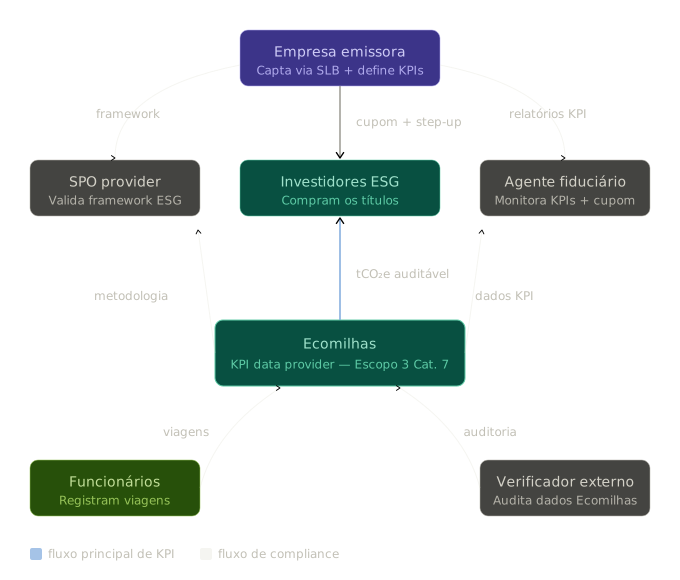
The value is Ecomiles acting as a KPI data provider and methodological framework for an SPO provider: we transform mobility/commuting data (often a meaningful Scope 3 block, when applicable) into standardized, traceable, audit-ready KPIs and a pipeline of initiatives with verifiable abatement and marginal cost (R$/tCO₂e) — ready to feed your MACC, targets (e.g., SLB/SLL), and decisions at speed.
image

How your company can monetize green debt with Ecomiles

Employee commuting may not be the single largest Scope 3 source for your organization, but it is one of the most measurable with credibility. At Ecomiles, we calculate emissions by transport mode using a methodology aligned with the GHG Protocol and generate audit-ready data.

With that, what used to be a diffuse number becomes a verifiable KPI — ready to be presented to investors, auditors, and regulators.

With this level of traceability, your company gains what’s often missing to structure a Sustainability-Linked Bond with a genuinely robust Scope 3 KPI: instead of a generic carbon target, you can commit to a specific, monthly, per-employee KPI with an evidence trail per trip.

This strengthens your ESG framework in front of the SPO provider, provides legal comfort for trustees, and delivers what investors demand most today: real transparency — not just declarative claims.

The practical outcome is a debt issuance at a lower cost of capital for targets your company can realistically deliver, because the data infrastructure to prove them now exists.

Ecomiles delivers the baseline, annual KPI reports, and the verification package from day one through bond maturity. Your company makes the market commitment; we make sure the numbers can defend it.

‣
1) A MACC-ready dataset (the missing “input”)

To build a reliable MACC curve, the company needs a consistent inventory of commuting behavior — and how different levers change that behavior.

Ecomiles consolidates the essentials: mode, distance, frequency, cuts by site/territory, and trends over time.

This reduces the cost of data collection and cleaning (usually the MACC bottleneck) and helps ESG teams focus on what matters: comparing initiatives by R$/tCO₂e and feasibility.

‣
2) Initiatives as abatement levers with standardized metrics

In corporate mobility, abatement can come from different levers, for example: increasing active mobility, modal shift, engagement campaigns, internal policies, incentives, and reducing avoidable trips.

Ecomiles structures these levers as measurable initiatives, with:

  • Baseline (today’s behavior)
  • Action (what changes)
  • Expected abatement (tCO₂e)
  • Cost (CAPEX/OPEX/incentives)
  • Timeline and dependencies

This enables apples-to-apples comparison — a prerequisite for a consistent MACC.

‣
3) Marginal cost and scenarios (where execution speed becomes “monetization”)

Monetization happens when the client can test scenarios and make decisions quickly:

  • Scenario A: focus on engagement + communication
  • Scenario B: more aggressive incentives
  • Scenario C: waves by site/territory

Ecomiles enables rapid iteration because the operational data is already in place and assumptions are documented.

The outcome is a shorter cycle time from analysis (days/weeks) to decision (hours/days) — increasing execution rate of the abatement plan.

‣
4) From a “MACC plan” to execution and tracking (a living MACC)

A MACC that never turns into execution is just a slide.

With Ecomiles, the client tracks plan vs. actual continuously:

  • Adoption and recurrence (success drivers)
  • Data quality and integrity
  • Impact in km and CO₂e avoided
  • Progress by site/territory

This closes the loop: it improves MACC assumptions over time and increases audit confidence — and supports smarter budget allocation in the next waves.

The strongest position on your MACC curve

We reduce Scope 3 emissions with high abatement potential and among the lowest costs per ton of CO₂e avoided (R$/tCO₂e).

image

Receive quarterly KPMG-audited data

Cuts by site/territory to support prioritization and governance.

image

Generate revenue from employees’ non-corporate trips

Cuts by site/territory to support prioritization and governance.

image

The most logical abatement lever on your MACC curve

Cuts by site/territory to support prioritization and governance.

image

Evaluate additionality and operational impact

Cuts by site/territory to support prioritization and governance.

FAQ

‣
Does this replace a GHG Protocol emissions inventory?

No. Ecomiles is a mobility and engagement solution that accelerates the commuting slice (when applicable) and turns it into quantified initiatives.

It complements the inventory and connects diagnosis to execution and tracking.

‣
How do we ensure consistent R$/tCO₂e (marginal cost) across sites?

We standardize what counts as “cost” per initiative (CAPEX/OPEX/incentives), document assumptions, and maintain territory-based cuts.

This allows fair comparison and scenario adjustments based on local policy.

‣
How audit-ready is the abatement?

The model is more audit-ready when assumptions and factors are documented and tracking is continuous.

Ecomiles supports evidence by cut (site/territory/period) and helps explain variance (adoption, recurrence, data quality).

‣
What if adoption is low and compromises abatement?

That becomes an explicit execution driver: campaigns, communication, and incentives are treated as levers with targets and ongoing tracking.

The client quickly sees where the plan is underperforming and can course-correct before losing the cycle.